Priority depends on more than urgency.
Intent, feasibility, time, place, people, and momentum all influence what should surface.
Context-aware prioritization
A mobile prioritization engine that continuously re-ranks work against the user's present reality—available time, location, people, resources, intent, and momentum.
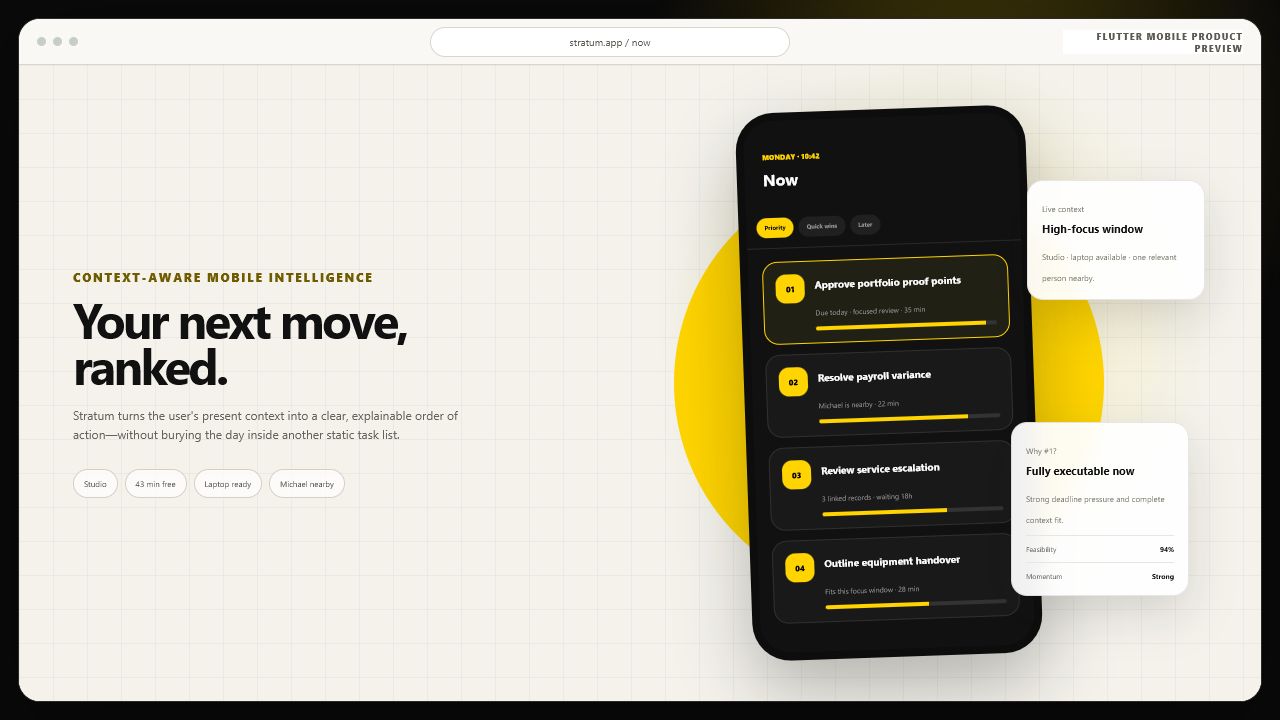
The yellow-and-black mobile interface makes the ranking model visible: work rises or falls as time, location, people, available resources, urgency, and recent momentum change around the user.
The product problem
Most task managers preserve user-entered order or a simple due-date sort. They cannot account for a fifteen-minute gap, the person currently nearby, the resources available, the user's scheduled location, or the cost of switching away from work already in motion.
Stratum treats priority as a dynamic score rather than a permanent label. Every task can rise or fall as context changes, creating a feed that answers a more useful question: what is the highest-leverage action I can realistically complete now?
Intent, feasibility, time, place, people, and momentum all influence what should surface.
Tasks connect to projects, areas, subareas, people, locations, schedules, and required resources.
Heavy graph computation cannot turn every feed refresh into an expensive multi-table query.
Product model
The product combines deliberate user intent with environmental feasibility. Work is not arbitrarily hidden; it moves between prominence bands as its context changes.
Tasks and subtasks connect to projects, areas, and subareas without flattening the user's broader commitments.
Time required, due dates, manual importance, resource constraints, location, people, and momentum contribute to dynamic prominence.
Nested locations and many-to-many relationships model where work can happen and who meaningfully affects it.
Schedule blocks establish available windows, domains, locations, and nearby people for the ranking engine.
Mission-critical work, relational boosts, contextual triggers, and deferred tasks remain visible in understandable bands.
Focused sheets support rapid creation and editing of tasks, domains, people, locations, and the metadata that changes rank.
Architecture
The normalized relationship graph protects flexibility, while precomputed context gives the mobile feed a fast, stable read path.
Entities and polymorphic edges preserve rich relationships. PostgreSQL triggers flatten ranking inputs into a JSONB compute cache so the feed does not reconstruct the full graph on every refresh.
A Flutter client, Riverpod state layer, Supabase backend, role-aware data access, scheduling integration, and local persistence foundations support a responsive cross-platform product.
Stratum's value is not another place to store tasks. It is a decision layer that continuously reconciles ambition with the constraints and opportunities of the current moment.
Build an intelligent workflowNext product
Strata Timetable →