A central operating system for high-value tools and equipment across construction sites, stores, and teams—designed to make ownership, movement, condition, and maintenance visible.
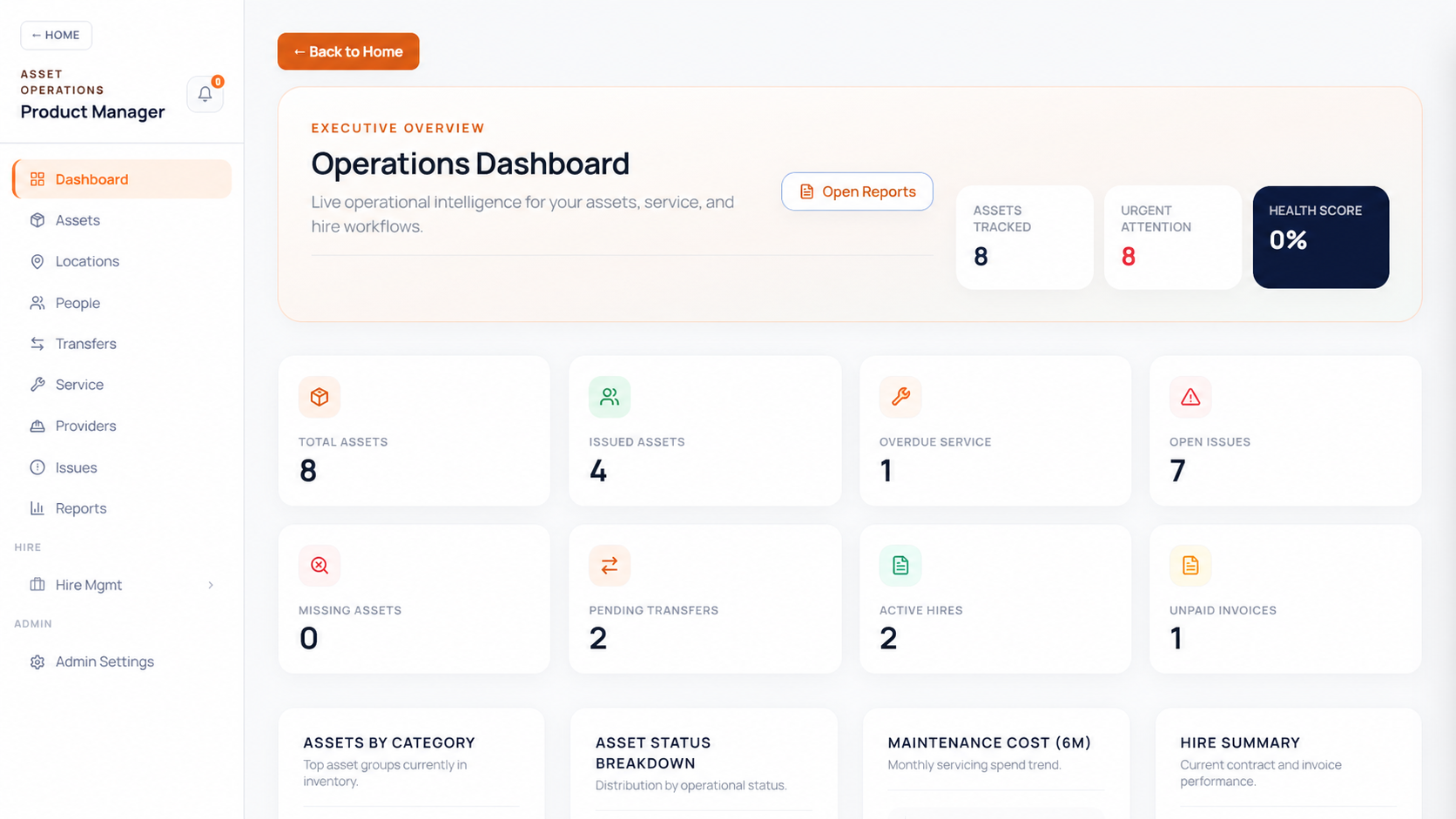
White-label operations dashboardA single operating picture across assets, maintenance, issues, transfers, hire, and invoices.
The dashboard turns daily records into operational intelligence: tracked and issued assets, overdue service, open issues, pending transfers, active hire agreements, and unpaid invoices stay visible in one decision surface.
Inside the live application
Nine connected workflows. One chain of custody.
The public tour explains the operating workflows while withholding client-branded interfaces, names, and production data. It moves from portfolio-level intelligence into an individual asset, controlled transfer approvals, issue response, hire availability, damage accountability, and commercial reporting.
Attention is organised before teams start opening records.
The executive dashboard connects asset distribution, overdue service, open issues, pending transfers, active hire agreements, unpaid invoices, and cost trends. Managers see where operational risk is accumulating and can move straight into the underlying workflow.
Cross-workflow health indicators
Maintenance and issue escalation
Hire and invoice performance
White-label case studyPortfolio analytics
Client identity and production data are intentionally excluded.
02 / Portfolio intelligence
Operational volume becomes a readable management picture.
Asset counts, category distribution, status, maintenance cost, hire performance, overdue work, and open issues are presented together so management can see both scale and immediate operational pressure.
Asset and status distribution
Maintenance cost visibility
Hire and invoice attention
White-label case studyAccountable asset record
Client identity and production data are intentionally excluded.
03 / Individual asset evidence
A single asset becomes an accountable operating record.
The Bosch Grinder record brings identity, current location, assigned custodian, condition, purchase information, warranty, service state, transfer history, maintenance, issues, and media into one operational profile.
Current ownership context
Technical and commercial details
Linked lifecycle records
White-label case studyTransfer request
Client identity and production data are intentionally excluded.
04 / Transfer initiation
The destination and receiving responsibility are explicit before movement begins.
The transfer form connects the selected asset and its current condition to a destination site and named receiver. Searchable location selection keeps operational choices controlled even as the site network grows.
Asset and condition confirmation
Site and person assignment
Approval-aware submission
White-label case studyTransfer approval
Client identity and production data are intentionally excluded.
05 / Transfer approval
Managers review the handoff before custody changes.
The approval view preserves transfer date, source and destination custody, condition, quantity, notes, and a visible audit trail. Approval and rejection are deliberate business decisions rather than silent record edits.
Manager approval controls
Before-and-after custody context
Visible workflow audit trail
White-label case studyIssue response
Client identity and production data are intentionally excluded.
06 / Issue response
Damage, loss, and operational risk stay visible until resolved.
The issues register connects each report to its asset, type, severity, reporter, assignee, and resolution state. Search and filters help teams isolate critical, open, or in-progress incidents without losing accountability.
Severity-led triage
Asset-linked incident records
Ownership and resolution status
White-label case studyHire availability
Client identity and production data are intentionally excluded.
07 / Hire availability
Commercial commitments are visible against time.
The availability calendar places hire agreements directly on an asset timeline, giving teams a clear read-only view of when equipment is committed and when it can be promised again.
Asset-level booking timeline
Month navigation and filtering
Agreement-linked availability
White-label case studyDamage accountability
Client identity and production data are intentionally excluded.
08 / Damage accountability
Hire damage is recorded with responsibility and financial impact.
Damage records connect the affected agreement or asset to the incident description, severity, responsible party, estimated cost, and resolution status, preserving the commercial context around the loss.
Agreement-linked damage history
Responsibility and cost visibility
Open-to-resolution tracking
White-label case studyHire reporting
Client identity and production data are intentionally excluded.
09 / Hire reporting
Commercial exceptions become management evidence.
Hire reporting brings active agreements, revenue, and overdue returns into dedicated views. The overdue-return report connects the agreement, asset, client, and due date and can be exported for operational follow-up.
Active agreement and revenue views
Outbound and inbound return exceptions
CSV export for controlled follow-up
The operating challenge
Accountability breaks when the asset record lags behind the real world.
Construction assets move between stores, sites, vehicles, and individual staff. A basic inventory list can show what exists, but it cannot reliably explain where an item is now, who accepted it, what condition it is in, or whether service work is due.
The platform was shaped as an operational source of truth rather than a static register. It connects routine actions—receiving, issuing, transferring, approving, inspecting, and servicing—so the record develops as the work happens.
01 / Traceability
Movement needed a clear chain of custody.
Transfers require accountable handoffs rather than silent record edits.
02 / Availability
Teams needed one current view of distribution.
Sites, stores, and assigned staff had to be represented in the same operating model.
03 / Asset health
Maintenance could not remain disconnected.
Service history and upcoming work needed to live beside the asset record.
What the platform does
Every critical action becomes part of the operational history.
The product separates responsibilities by role while keeping management visibility connected across the full asset lifecycle.
01
Central asset register
Maintains a structured record of equipment, condition, status, ownership context, location, and supporting information.
02
Controlled transfers
Models movement between locations and people with approval steps, receiving confirmation, and a durable history of handoffs.
03
Location and custody views
Lets authorised users understand how assets are distributed across sites, stores, and assigned staff without rebuilding the picture manually.
04
Maintenance management
Connects service schedules, maintenance activity, condition changes, and historical records to the asset itself.
05
Role-based operations
Provides distinct permissions and working views for different levels of operational responsibility.
06
Management reporting
Surfaces asset distribution, condition, maintenance, and operational trends through decision-oriented dashboards.
Product and architecture
Designed around controlled change.
Enterprise value comes from the integrity of the workflow, not the number of screens. The product design keeps high-consequence actions explicit and the underlying data model aligned with operational ownership.
Workflow architecture
Transfers and approvals are represented as business events with states and responsibility, preserving the context behind a change instead of only storing its final result.
Role separationApproval statesAudit historyOperational dashboards
Technology foundation
A modern typed web application and managed data platform support responsive administration, structured access control, and maintainable product delivery.
ReactTypeScriptSupabasePostgreSQLVercel
From “where is it?” to an accountable operating record.
The platform gives teams a shared way to act on asset information, not merely view it—supporting clearer ownership, earlier maintenance attention, and faster operational decisions.